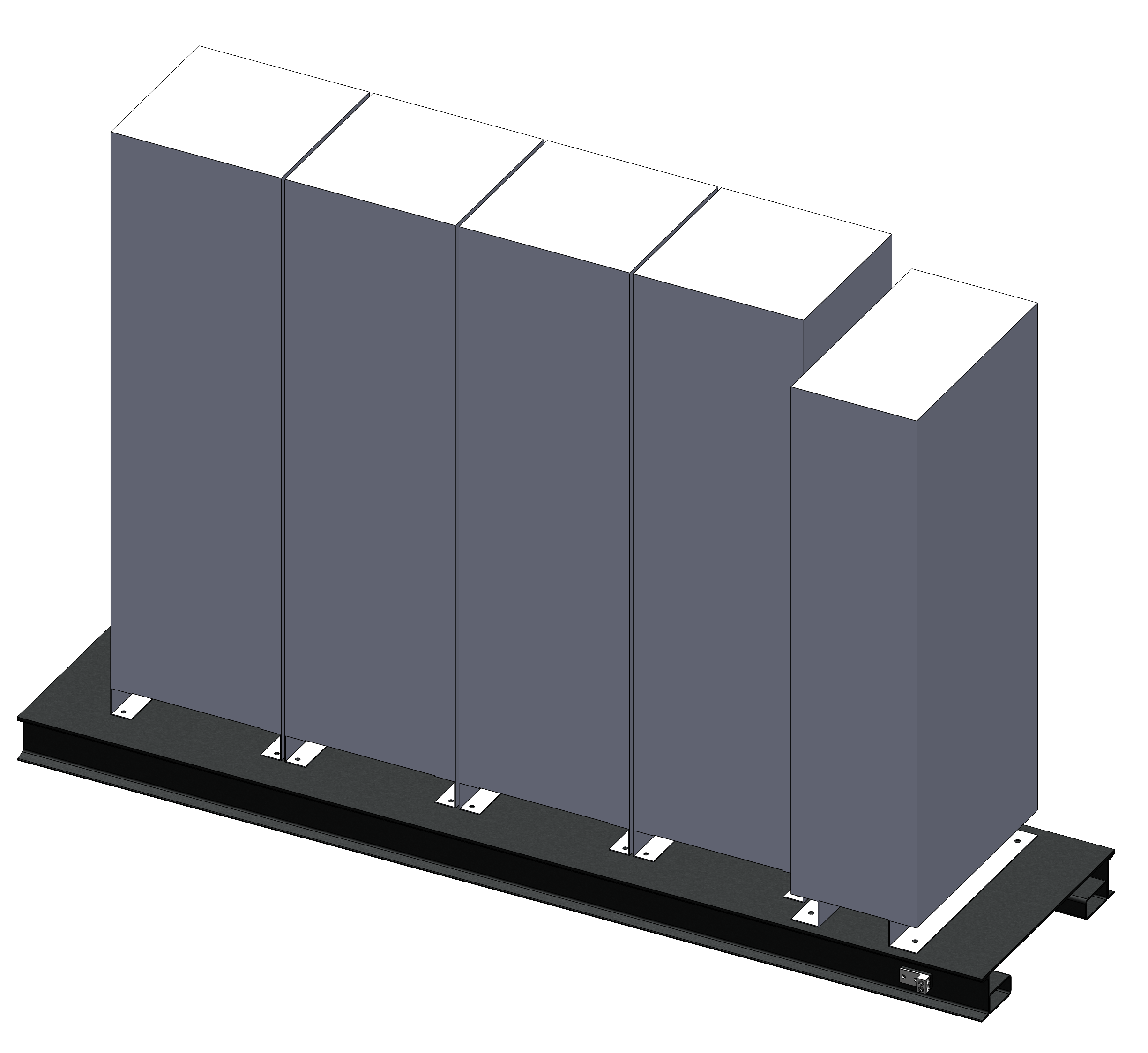
A well-specified skid arrives on site and drops in cleanly — your crew bolts it down, connects power, and walks away. A poorly specified one generates change orders, field modifications, and schedule delays.
Here are the five details that separate a smooth deployment from an expensive headache.
1. Equipment Layout and Weight Distribution
Don't just list the gear — provide a proposed arrangement or let us model one. We need:
- Cabinet dimensions (width × depth × height) for every piece of equipment
- Individual weights and total loaded weight
- Whether doors swing left, right, or slide
- Service clearance requirements (NEC 110.26 minimums, or your facility standard if stricter)
Why it matters: Weight distribution determines beam sizing, cross-member spacing, and lift-point placement. An unbalanced skid is a safety problem and a rigging headache.
2. Cable Entry and Exit Points
Specify where cables enter and leave the skid:
- Top entry, bottom entry, or both?
- How many conduits, and what diameter?
- Do you need cable tray, Unistrut, or open knockouts?
- Grounding bus bar location
Why it matters: If we don't know cable routing up front, you'll be drilling and welding in the field — inside an energized room.
3. Seismic and Environmental Requirements
Tell us:
- Seismic zone or IBC site class
- Indoor, outdoor, or covered outdoor
- Operating temperature range
- Corrosion exposure (coastal salt, industrial chemicals, etc.)
Why it matters: These drive steel gauge, bracing design, finish type (powder coat vs. hot-dip galvanize vs. stainless), and anchoring details.
4. Transport and Rigging Constraints
Think about how the skid gets from our shop to its final position:
- Maximum shipping dimensions (standard flatbed: 8'6" wide × 13'6" tall × 53' long)
- Doorway or corridor size constraints at the destination
- Forklift pockets, crane lift points, or both?
- Can it ship assembled, or does it need to break into sections?
Why it matters: A skid that's 1" too wide for the freight elevator means a field-split design instead of a monolithic one. Knowing this up front saves thousands.
5. Finish and Labeling
Specify:
- Paint color (RAL number) or galvanize
- Labeling requirements (equipment IDs, safety warnings, conduit tags)
- Any customer-specific standards (e.g., utility company specs, military MIL-STD)
Why it matters: Rework on finish is expensive and delays delivery. Get the spec locked before we cut steel.
The Quick-Reference RFQ Checklist
When you send us an RFQ, include:
- Equipment list with dimensions and weights
- Proposed layout or single-line diagram
- Cable entry/exit requirements
- Seismic zone and environment
- Max transport dimensions
- Finish and labeling spec
- Delivery timeline
With this information, we can typically return a budgetary quote within 48 hours and a detailed proposal within a week.