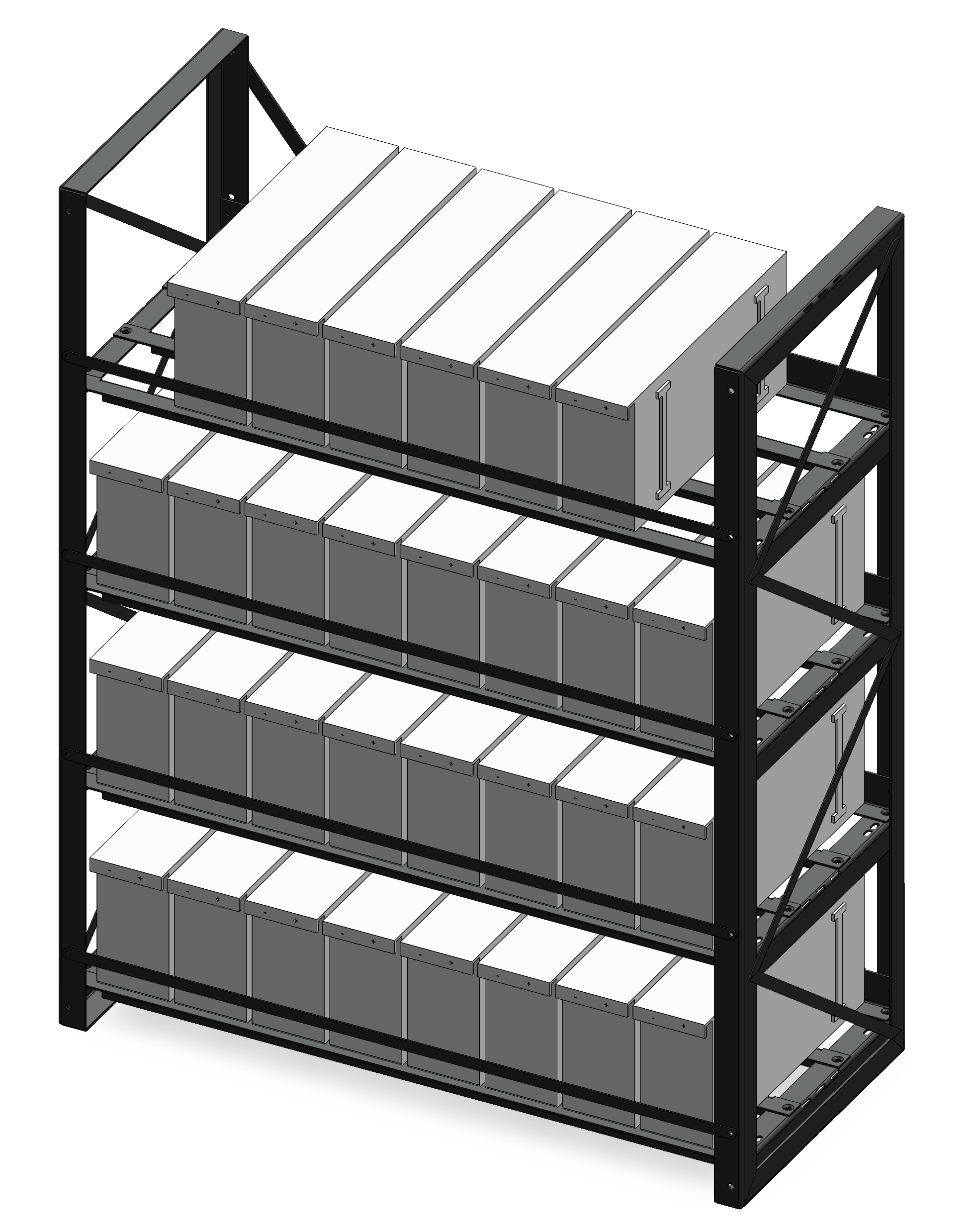
Battery strings are heavy, top-heavy, and full of sulfuric acid or lithium electrolyte. In a seismic event, an inadequately braced rack can topple, short-circuit, or rupture cells — creating a fire, chemical spill, or both.
Here's what you need to know when specifying racks for seismic zones.
Understanding the Codes
Two standards govern seismic rack design in the United States:
- IBC (International Building Code) — defines seismic design categories (SDC) A through F based on site location and soil class
- IEEE 693 — specifically addresses seismic qualification of substation equipment (relevant for utility-scale battery installations)
Most commercial and data center installations fall under IBC. Your structural engineer or AHJ (Authority Having Jurisdiction) will tell you the required SDC for your site.
Seismic Design Categories at a Glance
| SDC | Risk Level | Typical Locations | Rack Requirements |
|---|---|---|---|
| A–B | Low | Central US, low-risk soil | Standard anchoring |
| C | Moderate | Mid-Atlantic, some Midwest | Engineered anchoring + lateral bracing |
| D | High | West Coast, New Madrid zone | Full seismic frame with cross-bracing |
| E–F | Very High | Near-fault sites | Shake-table tested or calc-certified |
Key Design Elements
Anchorage
Every seismic rack must be positively anchored to the floor — not just sitting on its own weight. We design for:
- Concrete anchor bolts sized to the overturning moment
- Base plate thickness sufficient to distribute loads
- Anchor embedment depth per ACI 318
Cross-Bracing
Diagonal bracing (X-bracing or chevron) in both directions prevents the rack from racking sideways. We use:
- Structural steel angles or flat bar
- Bolted connections (not just tack welds) for inspectability
- Slotted holes where needed for field adjustment
Cell Restraint
The rack frame can be perfect, but if the batteries aren't restrained, they'll slide off the shelves. Options include:
- End stops and side rails (minimum for low seismic)
- Individual cell spacers with threaded rod tie-downs (moderate seismic)
- Full cell cradles with positive retention (high seismic)
Tier Height and Center of Gravity
More tiers = higher CG = larger overturning force. In SDC D and above, we typically limit racks to 2–3 tiers unless the footprint is wide enough to resist overturning without excessive anchor loads.
What to Ask Your Fabricator
Before you award a PO for seismic battery racks, confirm:
- "Can you provide a seismic calculation package?" — A legitimate fabricator will produce (or subcontract) a stamped engineering calc showing the rack meets your SDC.
- "What anchorage hardware is included?" — Some vendors quote the rack but not the anchors. You need the full system.
- "How are cells restrained?" — Vague answers like "standard end plates" are a red flag in SDC C and above.
- "Is the finish rated for my environment?" — Battery rooms can be corrosive. Powder coat is minimum; hot-dip galvanize or epoxy may be required.
Our Approach
At Balazs Fabrication, every seismic rack ships with:
- A calculation package per IBC/ASCE 7 for your specific site
- Anchor bolt templates and installation instructions
- Cell restraint hardware matched to your battery model
- Powder coat or galvanize finish per spec
We've built racks for data centers, telecom central offices, and utility substations in seismic zones across the western US.